
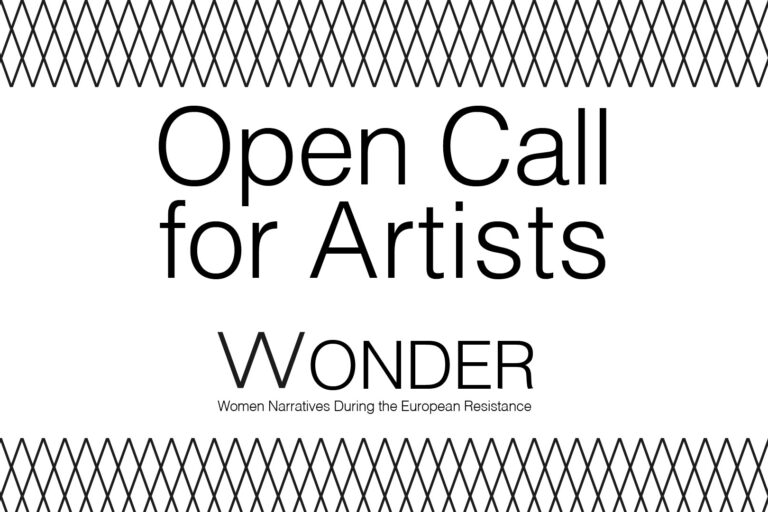
WONDER OPEN CALL FOR ARTISTS
WONDER sosterrà cinque artiste e artisti nella realizzazione di nuove opere capaci di mettere in dialogo la memoria storica e il presente.


Women’s Narratives During the European Resistance
WONDER
Women’s Narratives During the European Resistance
WONDER is a European project funded by the CERV program—Citizens, Equality, Rights, and Values—which aims to restore visibility to the role of women in the Resistance during World War II, highlighting their contribution to the fight against fascism and the building of democracy in Europe. Their commitment to justice, freedom, and peace, as well as their participation in the postwar democratic transition, represents a fundamental component of collective memory—one that is still often marginalized in official historical narratives today.
Throughout Europe, women participated in the Resistance in many different ways: they gathered intelligence, distributed underground propaganda, maintained links between groups, organized escape routes, provided logistical support, and, in many cases, took part in armed struggle. Despite their crucial role in anti-fascist networks, for decades these experiences remained largely invisible in historiography and institutional narratives, relegated to a secondary position compared to the male-dominated narrative of the Liberation struggle. Even the criteria adopted for official recognition of participation in the Resistance—based primarily on military parameters—have contributed to the underestimation of women’s contributions.
WONDER was created to help fill this gap in European historical memory and give voice to this “silenced resistance, ” recognizing women as fighters, organizers, couriers, leaders, and active protagonists in the anti-fascist struggle and the building of democracy. Through historical research, contemporary artistic practices, and community engagement, the project aims to foster reflection on the connection between memory, democracy, fundamental rights, and gender equality, while raising awareness of the role of women’s participation in strengthening democracies and protecting rights.
Objectives
WONDER aims to recognize and promote women’s contributions to the European Resistance and the postwar democratic transition by developing innovative and participatory approaches to research and the transmission of memory. The project aims to highlight often-overlooked stories and testimonies, foster dialogue between generations by involving young people, descendants, and communities, and contribute to the construction of a more inclusive, pluralistic, and shared European memory.
Another goal is to develop a model that can be replicated in museums and schools and to strengthen collaboration among European organizations and networks committed to preserving historical memory. In this way, WONDER aims to contribute to a broader awareness of the role of women in defending freedom, fighting totalitarianism, and building contemporary democracies.
Memory, Art, and Participation
The innovative aspect of WONDER lies in the dialogue between cultural heritage and contemporary artistic practices. Alongside historical and archival research—which is participatory and community-based—the project involves artists in reinterpreting the stories and memories of the Resistance.
The methodology is structured around three areas: documentation, education, and cultural production. The recovery and preservation of historical records are intertwined with learning and awareness-raising activities, while the arts serve as a tool for reviving memory and opening up new perspectives for interpretation.
The project involves the creation of artist residencies, workshops, exhibitions, and public events, complemented by webinars, online meetings, podcasts, videos, conferences, and a final catalog. This series of activities brings together research, artistic experimentation, and public participation, promoting intergenerational exchange and dialogue between different national contexts.
A European and Intersectional Perspective
WONDER brings together five European countries—Italy, Austria, Germany, the Netherlands, and Poland—to foster a dialogue among different stories, experiences, and approaches to memory, all of which share the common theme of the underrepresentation of women’s roles in the Resistance.
Through transnational dialogue, the project aims to contribute to the development of a shared European narrative by promoting cross-border cooperation, mutual trust, and active citizenship.
WONDER also adopts an intersectional approach, considering how inequalities in historical representation intersect with factors such as age, disability, immigrant background, and socioeconomic status. Particular attention is paid to respecting personal, family, and community memories and to creating safe spaces for dialogue, based on informed consent and care in the collection and dissemination of testimonies.
WONDER brings together six European organizations with complementary expertise in historical research, memory and museology, gender equality, education, participatory cultural practices, and artistic production.
ECCOM – European Centre for Cultural Organization and Management is the project leader and coordinates activities related to management, monitoring, quality assurance, basic research, communication, and the organization of the final conference.
The other project partners are:
OPEN CALL FOR ARTISTS
The open call for selecting artists to participate in the project is now online.
All the details are in the featured news item
Click here for the application form.
WONDER. Women’s Narratives During the European Resistance is funded by the European Union as part of the CERV program—Citizens, Equality, Rights, and Values—coordinated by ECCOM (lead partner) and carried out in collaboration with the Frauenmuseum Hittisau, FH (AU); Frauen in der Einen Welt Zentrum für Interkulturelle Frauenalltagsforschung und Internationalen Austausch e.V., FEW (DE); IAWM International Association of Women’s Museums, IAWM (IT); Stichting Herengracht 401, H401 (NL); Fundacja Instytut Beatboxu, FIB (PL).
The content is the sole responsibility of the authors and does not necessarily reflect the views of the European Union. Neither the European Union nor the funding authority can be held responsible for the content or the opinions expressed.
ECCOM European Center for Cultural Organization and Management
Hittisau Women’s Museum
Women in One World. Center for Intercultural Research on Women’s Everyday Lives and International Exchange, e.V. Women in One World
International Association of Women’s and Gender Museums – IAWM
Stichting Herengracht 401 – H401

Beatbox Institute Foundation – FIB
WONDER sosterrà cinque artiste e artisti nella realizzazione di nuove opere capaci di mettere in dialogo la memoria storica e il presente.


To provide the best experiences, we use technologies such as cookies to store and/or access device information. Consenting to these technologies will allow us to process data such as browsing behavior or unique IDs on this site. Refusing to consent or withdrawing consent may negatively impact some features and functions.

